Art Guide · Painters
Piet Mondrian
1872–1944
Piet Mondrian (1872–1944) was the Dutch painter who reduced painting to horizontal and vertical black lines and the primary colours red, blue and yellow. A founder of the De Stijl movement, he influenced everything from design to architecture.
Last updated: · Iconica Society editors
Life
Born in Amersfoort, he trained at the Amsterdam academy and in his early years painted Dutch landscapes and trees. After encountering Cubism in Paris he abstracted the tree motif step by step. In 1917 he co-founded the magazine and movement De Stijl with Theo van Doesburg.
He moved from Paris to London in 1938 and to New York in 1940, where the city’s lights and jazz inspired his last works. He died in New York in 1944.
Style and key works
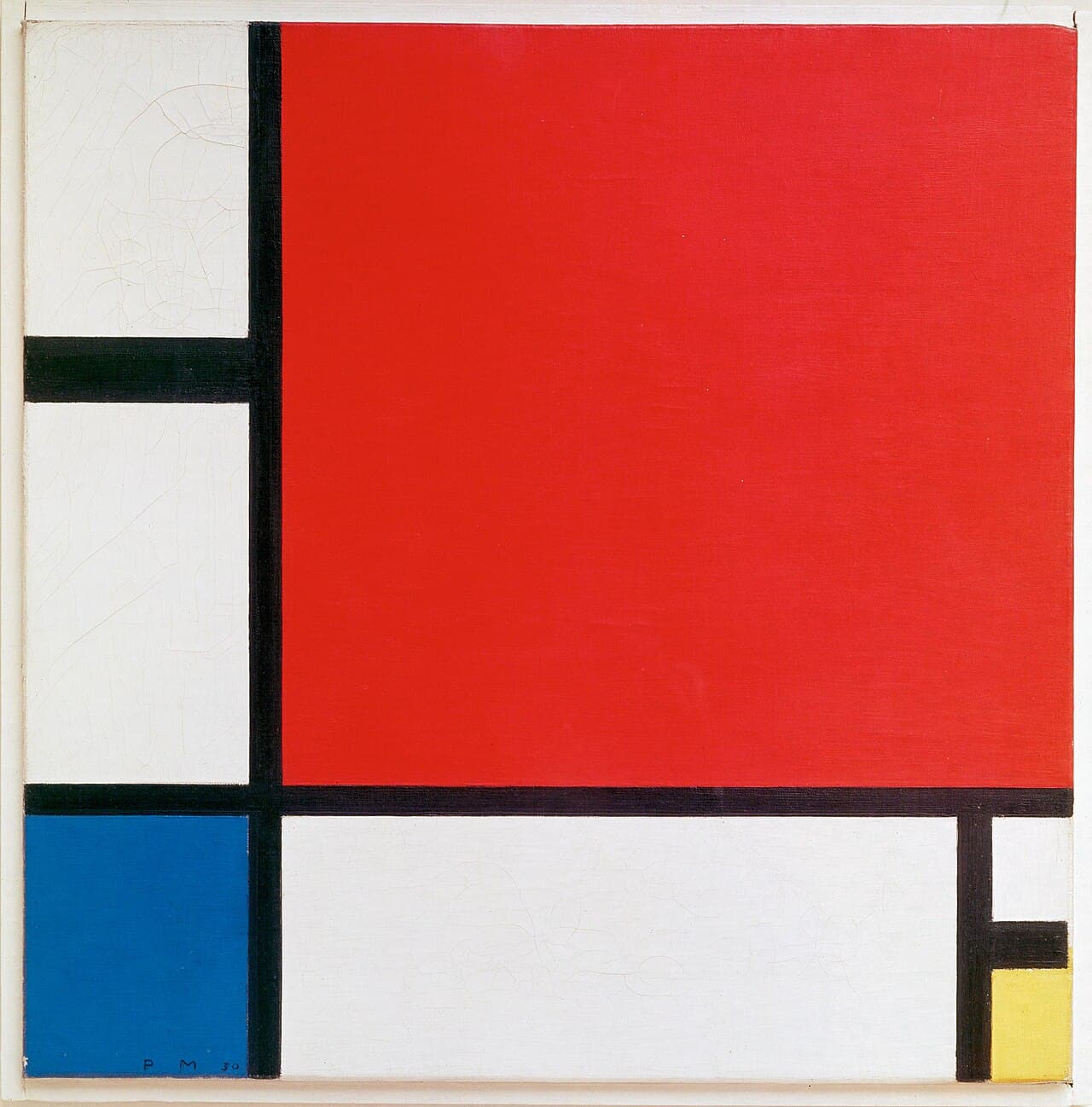
Mondrian’s approach, which he called Neoplasticism, uses only right angles, the primary colours and white, black and grey, aiming at a universal harmony and balance. Composition with Red, Blue and Yellow (1930) is its emblem. Broadway Boogie Woogie (1942–43), from his New York years, is his last major work, in which the black lines give way to bands of colour.
Key works
Shop Piet Mondrian posters →
Frequently asked questions
What is De Stijl?
A Dutch movement founded in 1917 by Mondrian and Theo van Doesburg that reduced art and design to horizontal and vertical lines and primary colours.
Why did Mondrian use the same colours?
He believed primary colours and right angles expressed a universal order beyond the personal and the passing.